Introduction:
This task required us to write a report based on the interviews with three graduates from the University of Melbourne to investigate their previous study life and current employment status. As a group of three, we first discussed the questions we planned to ask. Then each of us conducted an independent interview with one interviewee and recorded the conversation. Then, we transcribed those dialogues. After that, we worked together to write a report based on the interviews and provide some recommendations on study and work strategies for our future students as well as suggestions for our school.

(Image resource: https://www.unimelb.edu.au/)
Where is our future? Let’s hear graduates from
the major of Applied Linguistics of The University of Melbourne

(Image resource: https://en.wikipedia.org/wiki/Forensic_linguistics)
Declaration
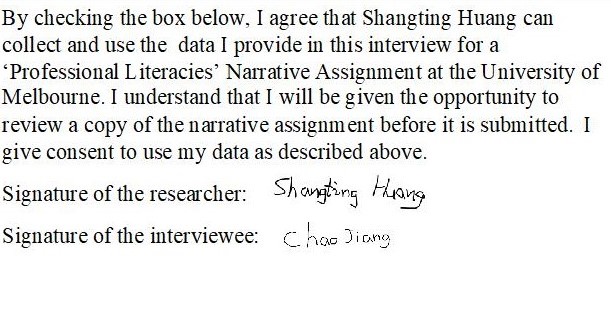
The interviewees, Eva, Chelsy and Daisy, have given us the permission to collect and use their data for the third assignment of ‘Professional Literacies’ at The University of Melbourne. They will be allowed to review the assignment before its submission.
We appreciate Eva, Chelsy and Daisy’s participating in
this study.
Executive summary
In this qualitative study, we aim to look into the employment status of Applied Linguistics graduates from The University of Melbourne. Three interviewees, Eva, Chelsy and Daisy, are all language teachers in three different universities in China. They strongly believe that the education they received from Melbourne University helped them find their current jobs. They offered us excellent suggestions on how to deal with school life and how to find a job by sharing their own experiences. The students’ experiences at the university show that the most challenging problem was how to write academic papers. Each interviewee made a different evaluation of the subjects that they took. For example, Daisy viewed that the subject of Second Language Acquisition was most useful for her current job, while Eva expressed that Quantitative Methods in Language Studies was more helpful for her. Chelsy, on the contrary, thought that none of the subjects are helpful for her current teaching job because all of them are too theoretical. She strongly recommended that the subjects should be more practical. According to them, future students should focus on the preview of reading materials before classes, active participation during lectures and tutorials and extensive reading after classes to get an excellent academic performance. For the workplace, they suggested that future students should research every possible information about the job that they are interested in, update their knowledge constantly and build teamwork skills while working. For the School of Languages and Linguistics, they expressed that it would be more helpful if the department could reduce the number of students in each class, provide more support on assignment and academic writing, and encourage students to publish papers and help students with supervised internships.
Table of Contents
1Introduction…………………………………………………………………………………………………….1
2Findings………………………………………………………………………………………………………….1
2.1Background Sharing…………………………………………………………………………………….…2
2.1Participant educational background before Studying at The University of Melbourne.2
2.2Regarding employment……………………………………………………………………………………2
2.2.1Job finding activities…………………………………………………………………………….……….2
2.2.2Participants’ relevant work experiences before their current jobs…………………………2
2.2.3Participants’ evaluation on the degree from The University of Melbourne……………..2
2.2.4The difficulties in participants’ current jobs……………………………………………………….3
2.2.5Participants’ short-term and long-term goals……………………………………………….….…3
2.3Reflection back to study life………………………………………………………………….……………4
2.3.1Three most significant advantages of studying at The University of Melbourne……….4
2.3.2One or two difficulties in participants’ study life………………………………………………….5
2.3.3Most helpful subjects for participants’ current jobs……………………………………….….…5
2.3.4Three pieces of advice to future students? …………………………………………………..….…6
3Recommendations and conclusion…………………………………………………………………………..7
3.1To future students……………………………………………………………………………….…………….7
3.1.1On learning strategies……………………………………………………………………………………..7
3.1.2Work related strategies…………………………………………………………………………….……..8
3.2To School of Languages and Linguistics of the University of Melbourne……………………..8
Appendices
Introduction
This study aims to offer advice to future Applied Linguistics students and the School of Languages and Linguistics through investigating the study experiences and employment situation of graduates from The University of Melbourne. We have three interviewees: Eva, Chelsy and Daisy. Firstly, we inquired about their basic background information and current employment status. Secondly, they were asked to reflect on their university life, including the most significant advantages of studying at The University of Melbourne. From the information that they provided on the most helpful subject for the current work and the difficulties they faced in their university life, we conclude that Applied Linguistics students will benefit from the interviewees’ responses and experiences that was discussed above.
- Findings
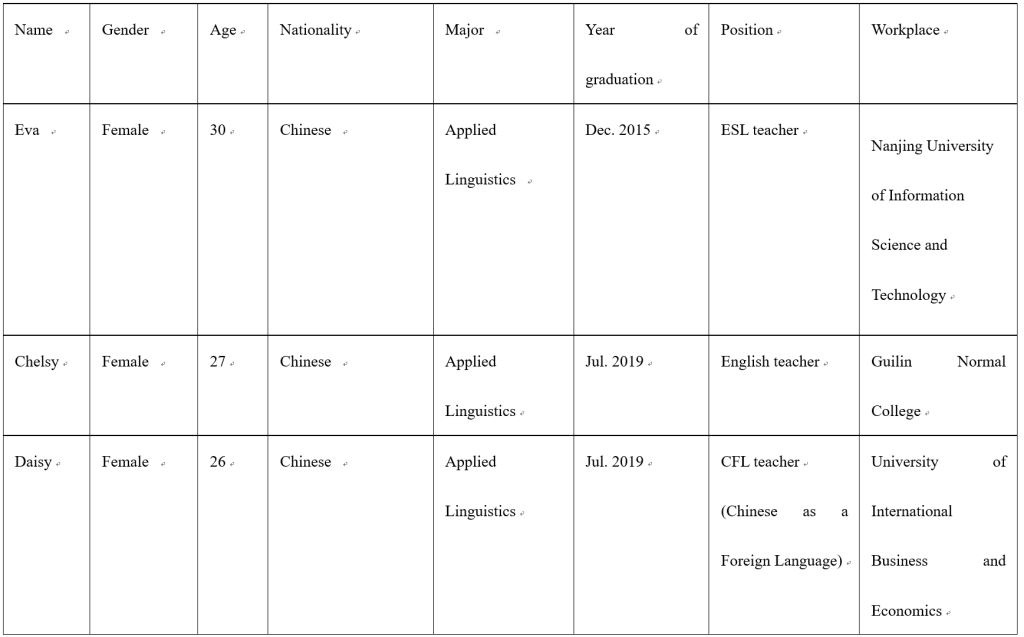
Table 1: participant details
2.1 Background Sharing
participant educational background before Studying at The University of Melbourne
Eva studied Bachelor of Arts (English) at Chongqing university. Chelsy completed a Bachelor of Arts (Business English) at Guangxi Normal University. Daisy finished a Bachelor of Arts (Teaching Chinese as a Foreign Language) at Xi’an International Studies University.
2.2 Regarding jobs
2.2.1 Job finding activities
Chelsy found her job through her aunt’s social connection. Eva and Daisy both found their jobs on the internet.
2.2.2 Participants’ relevant work experiences before their current jobs
They all had some relevant work experiences before securing their current job. Specifically, Eva had worked as an English tutor at a private educational institute before her master’s degree.
Chelsy had two internships related to teaching. The first internship was working as a teaching assistant at a Chinese language training school. Her role was to assist TCFL (Teaching Chinese as a Foreign Language) teachers to teach students and help students to have a knowledge of Chinese culture. Her second internship was teaching English in a primary school in her hometown.
Daisy did relevant work both in her bachelor’s and master’s studying period. She was an online intern Chinese teacher in her bachelor’s study period. While doing her master’s degree at The University of Melbourne, she worked as a part-time Chinese teacher at the New Chinese Language and Culture School in Melbourne.
2.2.3 Participants’ evaluation on the degree from The University of Melbourne
All of the interviewees agreed that the degree that they received from The University of Melbourne helped them to find their current jobs. They all considered that The University of Melbourne holds a high academic reputation. Eva mentioned that her position, a lecturer in ELT at a university, required a master’s degree. She also said, “the degree from The University of Melbourne is the biggest reason for me to get this job because The University of Melbourne is a famous university around the world”.
Chelsy also thought that the degree from The University of Melbourne helped when she was looking for jobs. Her employers knew that The University of Melbourne was a prestigious university, so graduates from this university should also be very good. Similar to Eva and Chelsy, Daisy said, “The diploma of The University of Melbourne helps me in job-hunting. It is a famous and reputable university”.
2.2.4 The difficulties in participants’ current jobs
It is inevitable to experience some difficulties in the workplace, especially as a new employee. Three interviewees all mentioned their difficulties in their teaching roles. Eva said that management of students’ behavior and teacher assertiveness was challenging at the initial stage, but gradually, she had managed to become more skillful and confident. Chelsy expressed similar concerns. Chelsy said that she found it was very difficult to guide students to participate in classroom discussions and discipline her class. She would like to learn more techniques on how to conduct a class to arouse students’ interest in learning English. In addition, she also felt that she needed to give students freedom to let them do autonomous learning and improve their critical thinking.
Daisy, on the contrary, did not mention the classroom management problem. She said the challenge in her work was that she did not have enough teaching experience. It was hard for her to teach in Chinese all the time. She often had to translate Chinese into English to help students grasp the main idea of the Chinese text.
2.2.5 Participants’ short-term and long-term goals
The three language teachers all shared their short-term and long-term goals. All three teachers have the same short-term goals namely, to achieve teaching and learning objectives. They all expressed the desire to succeed in teaching. They would like students to experience learning from their teaching in a positive classroom atmosphere. Eva and Daisy both mentioned that they were planning to pursue a higher degree and to further their professional development in their long-term goal. To be specific, Daisy hoped to write papers based on her teaching materials and data.
Although Chelsy did not explicitly mention her further study, she said, “My long-term goal is to become a qualified English teacher and then get promoted to be a lecturer and professor and make a difference in the field of English language teaching”. Like Daisy, she also desired to publish papers, and she would continue to advance her knowledge by learning the latest English language teaching knowledge.
2.3 Reflection on study life
2.3.1 Three most significant advantages of studying at The University of Melbourne
Daisy’s experience in studying at The University of Melbourne shaped her perspective towards life and others. Daisy said,” The studying at The University of Melbourne reshaped my character, made me more tolerant in accepting different cultural backgrounds and beliefs. I also learned to respect the uniqueness of individuals”. The experience not only changed her perspective about life but also changed her methodologies. “My methodology theories have also changed. Now I am able to encourage students more and prepare my lessons to be more student-centered, and I learn to see from students’ perspectives”, Daisy added.
Chelsy echoed with Daisy’s first opinion. She said, “Through the communication with my lecturers and the group work with my classmates who are from different countries, I have gained different perspectives and angles at looking at different problems”. Apart from it, Chelsy also mentioned that the experience of studying and living abroad had made her more independent and this experience was precious to her.
In addition to the knowledge they acquired from their study journey at The University of Melbourne, Chelsy and Daisy also acknowledged that the degree of Master of Applied Linguistics that they received from The University of Melbourne helped them to find their jobs. Daisy added that the major of Applied Linguistics aligns with her work, which consolidates her foundation of theories in her work.
Different from what Daisy and Chelsy said, Eva looked at her studying at The University of Melbourne from a different perspective. Eva said that she liked the location of Melbourne University best because it was near the city centre, where she could enjoy the convenience of public transport. In addition, because she was surrounded by high-achievers on campus these diligent students motivated her to achieve higher. The last thing she mentioned was that the historic buildings in the university were beautiful, which could make nice Instagram photos.
2.3.2 One or two difficulties in participants’ study life
In terms of the difficulties in their study life, Eva and Chelsy both mentioned that life was a challenge at the beginning of their university life, though the two have different reasons behind it. Eva felt very lonely in the first two months upon her arrival. And she couldn’t concentrate on class because of this loneliness. However, Chelsy said it was hard for her to adapt to a new education system, which is different from Chinese education system, at the initial stage. “At The University of Melbourne, compared with Chinese universities, the lecturers from The University of Melbourne do not explain basic contents and concepts during the class and only lead us to analyze and discuss the theories. The lecturers here expect us to prepare ahead of lectures before class and do lots of readings before class. If we don’t do readings, it would be so difficult for us to follow the lessons”, she explained.
Apart from the difficulty of entering a different environment, Eva and Daisy also found that academic writing was difficult for them. Eva said that she had much self-doubt when writing her dissertation because English is not her first language. Daisy said, “The biggest challenge in my study life was writing academic papers. I couldn’t write it very well. Reading was also very challenging, and I couldn’t get the gist of readings perfectly”.
2.3.3 Most helpful subjects for participants’ current jobs
Eva and Daisy each named one subject that they thought was useful. According to Eva, the subject of Quantitative Methods in Language Studies was most helpful for her job. It gave her confidence to do some research. Most importantly, it enhanced her critical thinking and analytical abilities, which benefited her teaching job at the university. Daisy thought that all of the subjects that she learned were very helpful. Among them, she felt the most useful subject was Second Language Acquisition. “The methodology theories inspired my current teaching job. For instance, the subject accented on the importance of input, so I know the significance of imparting knowledge. The subject also emphasized on output, so I encourage students to speak more in class. “Daisy presented a comprehensive explanation.
However, unlike Eva and Daisy, Chelsy held a more practical perspective. She commented, “Our subjects are not very helpful for my teaching because our subjects focus more on linguistic theories. However, teachers should be equipped with more practical and professional skills, such as how to write lesson plans and how to manage the class very well, which are not learnt from our subjects”.
2.3.4 Three pieces of advice to future students
All three graduates mentioned preparation for the course of study before arriving to Melbourne. Eva and Chelsy emphasized the importance of preparing before classes. Eva said, “Get ready for your study at The University of Melbourne before arrival, for example, by familiarizing yourself with the course requirements”. Chelsy suggested that future students should prepare themselves well by reading all the required texts before each class. Daisy suggested that future students should make the most of classes by exploring the benefits that this university provides. For example, consulting professional professors for help when needed, using libraries for research, and utilizing sporting facilities and gyms.
Eva and Chelsy expressed the significance of communication with others. Specifically, Eva said,” Communication with your teachers and supervisors, seeking their advice will provide a pathway to your career opportunities”. However, Chelsy focused more on communicating with peers and lecturers who are from different countries.
Apart from communication, Eva and Daisy both mentioned experiencing different cultures and broadening horizons. Eva commented,” Read extensively and intensively not only to complete coursework but also to broaden horizons and deepen your insight”. Daisy focused more on the appreciation of different cultures and to enjoy Australian culture. She said,” Try to enjoy Australian culture as much as possible. Do not grade cultures. Trying to appreciate and respect every culture”. Daisy’s third advice to students was “to have a life”. “even if it means sitting by the side of Bourke street watching street shows” she said. Enjoy your life and travel the country to experience Australian culture.
Lastly, Chelsy raised the importance of living a balanced life. She advised students to have good time management skills to balance their study and life well and not to worry about their studies all the time.
3 Conclusion and Recommendations
The aim of the research was to look into the employment situation of Applied Linguistics graduates of The University of Melbourne. Through the interviews, we conclude that the degree from the University of Melbourne has made a great contribution to our interviewees’ current employment. Having a good communication skill and diligent study habit during university life also positively influenced their professional development.
By taking the responses from the interviewees, and together with our reflection and analysis, we are able to offer following suggestions to future Applied Linguistics students at The University of Melbourne. Furthermore, some suggestions are also provided to School of Languages and Linguistics at the university. However, due to the small interviewee sample, our recommendations may need further research to be more convincing. Future studies with a large sample size would be strongly recommended.
3.1To future students
3.1.1On learning strategies
The importance of study. Try to preview and do readings before classes, so that students can get themselves prepared for classes and be more focused in classes. Try to use all the support that the university provides, such as libraries and workshops.
Converse more with peers and lecturers who are from different countries. Studying abroad is an excellent experience to emerge ourselves into diverse cultures which can broaden our minds and take different views. Therefore, it is better to use this opportunity and converse with people from different cultural backgrounds.
Try to improve time management skills. To keep balance with study and social life, and to be more efficient. Trying to make a schedule with all the deadlines to remind ourselves and plan ahead, so that we do not miss deadlines. Make a to-do list and prioritize tasks. In this way, we can make our lives more manageable.
3.1.2Work-related strategies
Get enough information about job-hunting. It is suggested that future students should try to be familiar with all sorts of online resources to find more information about their desirable jobs. These include all the support provided by The University of Melbourne and online job-seeking resources.
Update our knowledge constantly. Future students are encouraged to do related internships to get them better prepared for their future jobs. They are also encouraged to participate in professional training programs to meet job requirements.
Hone teambuilding skills. Teambuilding skills are essential in the workplace. Therefore, it is necessary for students to learn to collaborate with others, to respect supervisors and colleagues, and adjust themselves to accept different point of views.
3.2 To School of Languages and Linguistics of the University of Melbourne
Reduce the number of students in each class. It is suggested that 50 is the maximum number of students in a lecture because it is hard for lecturers to focus on each student if there are too many students. A large number of students also has a negative effect on teaching activities.
Provide more support to assignment writing and academic writing. It is common to see that students are struggling with assignment writing. Then it would be better if more tutorials and academic writing classes are provided. These could create a smoother master student transformation and decrease students’ confusion in their assignment writing.
Further encouragement and support could be provided for students as they further their studies and pursue career paths. It would be better if every lecturer can encourage students to publish papers, especially those who want to pursue a PhD degree. At the same time, if supervised internships were introduced in the course, students who aim to go to the workforce after graduation could get more practical skills in teaching. Supervised internships could help students become more prepared and confident in the job-hunting process and their future work.
Appendices:
Appendix 1:
Interview Questions
- Would you like to share your background? (gender, age, subject/degree, international/local student etc).
- What is your educational background before the University of Melbourne?
- How did you find your job?
- Did you have any relevant work experience before this job?
- Did you think the degree from the University of Melbourne helps you find this job?
- Have you experienced any difficulties or challenges in your current job?
- What are you short-term and long-term goals?
- Can you name three most significant advantages of studying at the University of Melbourne?
- Can you name one or two difficulties in your study life?
- Which subject do you think is most helpful for your work?
- Can you give three pieces of advice to future students?
- Can you give three pieces of advice to the School of Languages and Linguistics?
Appendix 2
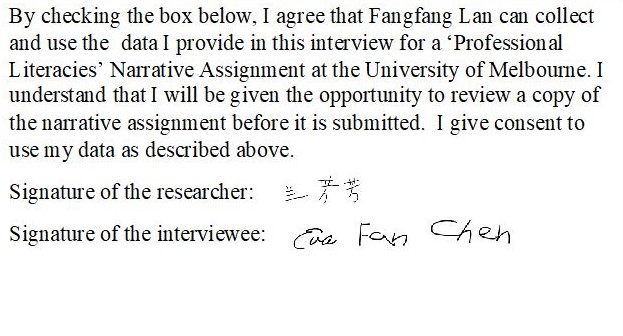
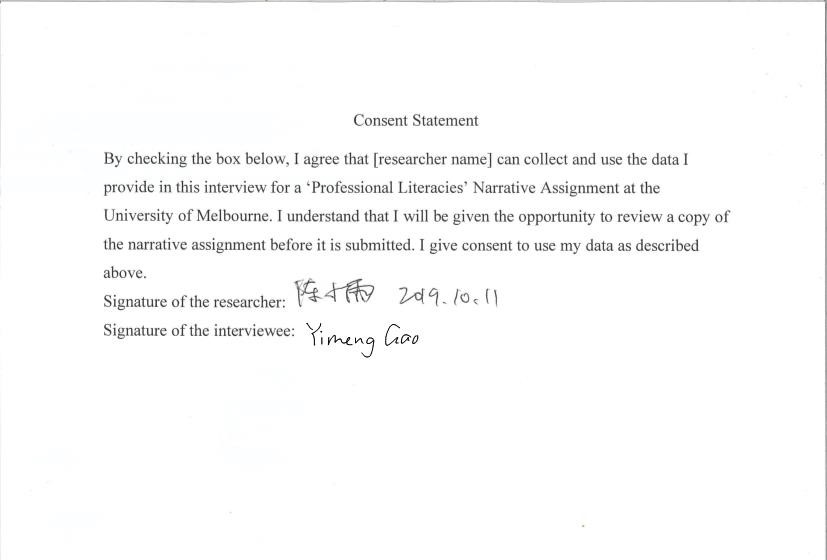
Consent Forms
Reflection:
This is the first time I have interviewed anyone. I think it is a great opportunity for me to learn more about graduates’ study and work experience, which can help me prepare for my own study and career. I am very grateful to all three participants for their willingness to share their personal stories with us.
To be honest, at the very beginning, it was difficult to find suitable and helpful interviewees. However, through diligent searching, we finally found three graduates of applied linguistics from the University of Melbourne who were willing to take the interviews. All the experiences of the interviewees inspired me to study hard and become an EFL teacher in the future. During the process of writing the report, I learnt how to design interview questions logically and how to cooperate in a group. All the team members got along very well and contributed a lot to this report. We discussed again and again to come up with a better outcome. No one has ever complained about so many meetings after class and so much editorial work which I am very grateful for. This assignment not only developed my writing skills but also enhanced my social and collaborative skills.
 Echo's home